A very short post, because the video says it all, but this is such a great example of rethinking I am most impressed.
Taking the water out of the toilet, and also capturing the methane gas is such a great idea, and it’s going to have such a huge impact, because of the volume of people and geographies it can help. The Dispose Waste “what” will always be there, but with the increasing pressure on our water supplies, eliminating the use of drinking water to remove waste is a huge step forward.
Now I don’t expect upscale neighborhoods like Beverly Hills to get rid of their flush toilets anytime soon (except maybe someone like Ed Begley, Jr who is cartoonishly environmentally friendly), but there are places all around the country and the world that this can help.
I am a little skeptical about whether there is enough methane to power our stoves, but it’s still all very clever.
It does seem like making the toilet out of manure is a bit much, but if the poo, I mean shoe, fits . . .
-Ric
Posted by (1) Comment
Lately people including Fed Chief Timothy F. Geithner and ecnonomist Paul Krugman have gone on record saying it’s too early to declare victory on the the global recession despite reported progress on many fronts. While Geithner focused more on the importance of the timing of the “unwinding” of extraordinary government policy measures put in place to protect markets, and Krugman spoke more of a cash “liquidity” trap, I was surprised by the continued absence of one thing in these and other conversations about the recovery – a definition of success.
Yogi Berra, the baseball player-cum-insurance-pitchman was quoted as saying “If you don’t know where you are going, you might wind up someplace else” and my growing concern is that with all of the money and smart people focused on this problem, it’s not clear that everyone is pointed in the same direction, or that they even will recognize or agree on a finish line when we get there.
I appreciate that there are some very complicated issues, especially in the financial markets, but there ought to be specific measures that can be articulated so that we can all get a better sense of where we are. Here are five areas that strike me as vital to tracking our progress through this situation:
1) Debt. Governments around the world have been borrowing and creating huge budget deficits, can’t we quantify or speculate how much of this borrowing the markets can sustain so we can sense how much worse it can get before even more serious measures are needed?
2) Risk. The basic notion, and math, related to risk was badly abused widely and broadly in the financial services sector, from mortgages, to the then bootstrapped mortgage-backed securities that grew the risk to cartoonish proportions. Can we quantify the risk of the bank debts today and report against the progress being made? What is the metric for tolerable banking and insurance risk to start talking about exit strategies.
3) Main Street. With so much talk about fixing Wall Street, we also hear about continued foreclosures, bankruptcies, and unemployment. Thankfully a lot of people have not lost their jobs, but aren’t there some numbers, even by region that show progress and draw some line above which things are now “OK”, at least? Some regions will always be doing better than others, so it’s probably not a bad idea to have some sort of reporting mechanism like this so that the next time it happens, we can start to see which regions are suffering, how badly, and when/if action is needed to help them get on their feet.
4) Liquidity. Growth, innovation, and fixing things all cost money. Lots of organizations from banks to businesses lack the financial liquidity to make key investments today, and I think we should be able to have measures that tell us where liquidity is an issue (by company and/or geography) so that decisions about how/if to handle them make sense. This is a level of transparency that we should have today and it will serve us well in the future.
5) Regulation. Some say that the way to prevent this kind of mess from happening again is significant new regulation that will force transparency and accountability. While there is little argument about the lack of transparency and accountability playing a key role in the current situation – how to fix this is open to a livelier debate. There need to be clear statements about how much oversight and regulation is needed through each stage of the recovery. In some cases I expect Mr. Geithner is right that there needs to be some unwinding as we go from”red” to “yellow” or whatever indicators are used, but specifics need to be included.
Many of us have felt the impact of the current crisis in some way in our personal lives, and it seems that it would go a very long way to have some sort of scorecard, consumable by the masses, that tells us where we are, and whether we should be more or less worried when we go to bed at night, whether we can afford that new jacket this month, or whether we need that insurance that Yogi talks about.
Given how much depends on the success of all of these efforts, shouldn’t we really work to define “what” success is at some level of detail before we get into debates about “how” we do it, and when we are finished? Not to suggest everyone will agree with the definition, but at least with a definition we can all have greater context for why decisions are, or are not being made.
-Ric
I have talked a lot about the online retail bank ING DIRECT and how they made some really fundamental changes in their operating model to take advantage of the internet. Retail banking was a commodity service from the beginning, but location was where differentiation came in (a little bit like gas stations). So when the internet (and the ATM) made location irrelevant, ING DIRECT realized they could target (and ignore) very specific sets of customers, and succeeded. “What” they were doing remained they same as all other banks, but “”how” they did things like interest rates (very high for savings accounts) and withdrawals (no paper checks) were very different. I think a lot of other retail banks haven’t changed their operating models much, still, because they don’t realize one of the basic assumptions of their operating model (that location differentiates) is now largely flawed.
So when I read this article in the paper today about credit cards, I couldn’t help but think the credit card companies are also operating in a model where some of the most basic assumptions that used to be valid, aren’t any longer. The article starts out talking about the Credit Card Accountability , Responsibility, and Disclosure Act and then compares credit union credit card rates and fees with the rest. While I am no expert in the new act, I think the article actually missed the larger issue. Back in the 1970s and 1980s when credit cards were just getting going, a credit card was a luxury and a privilege (American Express rejected me at least once, and they didn’t even let people carry a balance), and to my recollection, we never even talked about interest rates. It was a handy utility that really saved you the trouble of carrying cash (and Karl Malden was still selling traveler’s checks with his “don’t leave home without them” pitch).
Today, invitations to add another credit card are literally junk mail. It is no longer a luxury, or a privilege to have a credit card, and I hear often that the average American is carrying over $6,000 in credit card debt. So what?
The issue is that the credit card companies, like the retail banks (other than ING DIRECT) still think about themselves. Credit card companies think about what their profit goals are, and they use the entire pool of customers to manage their risk. As the article points out, a lot of the fees and interest rate issues are because so many people don’t pay their bills. The obvious solution to me is that credit cards should be more like insurance companies in the sense that they can check out our credit score and based on that assess our risk, and then it would again be a privilege to get the “best” cards with the lowest interest rates, but people would have to earn that right and then those of us with good credit ratings wouldn’t have to pay for the debts of others who can’t or won’t pay their bills. That’s what’s in it for the customer, and I think that’s very fair, but what’s in it for the bank is a much more attractive risk profile, and on top of that, if they would rethink interest rates, and not treat them as a punitive tax, but in fact a luxury (for people with good credit ratings), they could offer closer to market rates on interest, and I might actually start carrying a balance if the interest rate was reasonable, and that would be an entirely new source of income for them (which, in volume, would be worth the trouble).
This seems like an obvious solution for credit card companies, and it also seems like a way to help shore up debt and debt risk on main street.
-Ric
Netflix, the poster child of a company that created a totally new operating model in the video rental business by taking the store and the late fees out of the equation is losing market share. Blockbuster was the big loser in that one, and I talked about it a year ago with several people who shared my confidence that the Netflix market dominance would not last. Many of us we confident that Netflix would become the next Blockbuster as streaming media took off, giving Comcast the upper hand.
But it seems we were wrong.
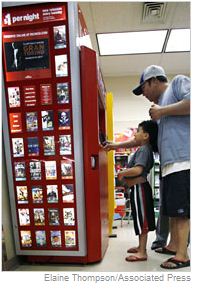
It appears that Netflix was right that customers don’t need to go to the video rental store to get their movies. What we overlooked was something that the people who brought us ATMs and Cranium games figured out a long time ago, which is that if you take your product to where your customer has to go anyway (like a grocery store), it will sell if it’s priced right.
It seems a little company called Redbox is the biggest threat to Netflix (and maybe Comcast) though Comcast wasn’t mentioned in this article today. Redwho?
Today Redbox has more than 15,400 video vending machines (and continue to add about one an hour) that hold about 700 movie DVDs that they rent for $1 a day with no late fees. I am not surprised the $1 per rental fee with no late fees is appealing, but I am a little surprised that the model works, because you still have to return the DVD (and keep the selections fresh), but $154 million in annual sales can’t be wrong . . .
The Cranium games people put their games in Starbucks and of course now the ATM is pretty much everywhere, and that’s some great rethinking around product placement and getting into the head of the consumer and thinking about what they want and where. I do think there is a valuable lesson for other companies (or potential new companies) to ask if they should rethink where they put their products (and how they price them).
As an aside, the article also mentioned that Redbox is now owned by Coinstar, the company that has the “vending” machines that you take all of your loose change to and get cash back. This seems like a great and logical brand extension for Coinstar, both in terms of the machines, the locations, and the target customers, so bravo Coinstar. Though it seems hard for Coinstar to, umm, change now, but since Netflix has a reddish logo, it would make some sense to have a color other than red from a competitor, especially since Coinstar is (almost unavoidably) green. But hey, if the shoe fits. . .
-Ric
This interview (click here)was coducted at the Six Sigma IQ headquarters in New York with Genna Weiss, their Senior Editor. For more information about Six Sigma IQ, visit http://www.sixsigmaiq.com
I will admit that when I saw this article in the paper this morning, I was a little surprised to learn that Reader’s Digest was still in business. I was very dyslexic as a child, and to help me get through that, I took “language training” classes after school (thanks Mom and Dad for that, by the way) and as part of that, my teacher Mrs. Bassett had me read articles from Reader’s Digest and then she would quiz me on comprehension ( I still remember the one about the prehistoric fish the Coelacanth they caught off the coast of Madagascar – I thought that was one of the coolest things I had ever heard).
In any event, I found the article fascinating for two reasons.
First, the fact that they hired Mary Berner, who sounds a little bit like the second coming of Katie Couric, to establish a contemporary market for the publication. Berner was quoted as saying “it’s traditional, conservative values: I love my family, I love my community, I love my church” and that clearly puts middle America in the crosshairs of their focus. So I love that they are aware of their need to rethink the publication and who their customer is and who will read it. I went out to their web site to grab some images and the main page had this photo of Father’s Day recipes that sounded very much in line with what Ms. Berner was saying. I can’t wait to hear how they do.
The second thing that interested me about the story is that Reader’s Digest adds another layer to the discussion of what is the future of publishing and content. The article points out that Reader’s Digest was a standard just like Life magazine, The Saturday Evening Post, and others, and so as we see newspapers shutting down and sites like Twitter now being discussed as potentially viable news sites, the conversation starts to take on some new dimensions where a couple of things have clearly started to happen. For at least ten years now news web sites have posted the one line article summaries that get our attention, and we click on the ones we like, and in a certain sense Twitter has empowered us to decide what we think is interesting and newsworthy and so as people develop followings, the more popular people on Twitter drive what people want to read.
At the same time there are reading devices like the Amazon Kindle, which by itself is interesting because of it’s ability to hold so many books, but more interestingly is the fact that you can buy individual chapters of books (much like we have seen in the music industry selling individual songs). The trend I think we will want to follow is the “size” of the content that people want to consume. If you look back at old issues of The New York Times, a lot of their articles used to be a lot longer.
What makes Reader’s Digest so interesting is that they have always been in the business of condensing stories, so beyond Ms. Berner’s question of who her market is, I think a more interesting question for everyone is what size article or story will appeal. At this point, the article size question will have a different answer for different demographics, but I think it’s a really interesting set of trends and topics and I will continue to pay close attention as so many organizations rethink the future of publishing, or “content consumption” (maybe I am saying that because that picture of a steak is making me hungry) which is what the larger umbrella term might become. . .
-Ric
Posted by (0) Comment
I was not surprised to learn that Eddie Bauer had filed for bankruptcy in this article. Eddie Bauer is a great example of a company that abandoned its roots, drifted into a different operating model, and never really connected with a core set of customers (which is in many ways similar to what GM has done to itself) in the new operating model.
The retail clothing chain got its start in Seattle where I grew up, and I have vivid memories of going into their great big downtown store in the early 1970s with my Dad, seeing camping equipment, shotguns, fishing rods, and lots of down jackets. For many years their quilted down jackets (which Eddie Bauer himself patented) were their signature item and it seemed as though every grownup had one.
I remember going to their store when I was in high school in the 1980s and overhearing that they were getting rid of their gun department. Then as the 1990s approached, they eliminated their fly fishing department. Fishing and hunting departments were replaced with sweaters and golf clothing. Since then, I have gone into the odd Eddie Bauer in a mall from time to time hoping to find a last minute Christmas gift, and every time I go in, I see that it has become a not-so-special store and I wonder why people shop there (I haven’t had any success with the last minute Christmas gifts). Clearly no one has filed any product patents on behalf of the store for a long time.
I am not saying it’s a mistake for a company to shift, or expand focus. Eddie Bauer actually started his shop as a tennis shop, and Nordstrom started out as a shoe store (though in the case of Nordstrom, shoes remain a big part of their brand). My issue with Bauer’s is that as they got away from sports, fishing, and camping, they failed to establish a deep connection with customers in their other products, which is why they have been adrift and flirting with bankruptcy for so many years.
The first of the three business value pillars that I talk about in the Rethink book, is being clear about which specific blocks of work in your organization are most valuable to your customers, your partners, and your employees – those are the ones that make up the brand and identity of the organization. I am not suggesting that bringing back their gun department will solve their problems – times have changed, I do think there’s plenty of room for innovation in outdoor clothing, and I would probably start there, and use that differentiation to connect with customers who value whatever it is they come up with.
It’s a perfectly rainy day in Seattle today, I am going take my son fishing – the perch are really biting in the lake at this time of year.
-Ric
This morning I read this article in the paper and I was delighted. Health care in this country is in need of some first aid of its own, so when I read some of the ideas about ways President Obama is rethinking how to drive the right behaviors, and accountability through transparency, I almost wish I had delayed the publishing of my book because it’s starting to sound like it would have made a fantastic chapter.
Some of the specifics of the article get complicated, and I am a little wary that we have enough evidence that extending additional “liability protection to doctors who follow standard guidelines for medical practice” will resonate with the field, but I think it’s a fantastic first step. Medical malpractice suits have made headlines many times over the years, and while I haven’t kept score, it does seem as though there have been more reports of “bad” doctors than patients filing frivolous law suits.
So bravo President Obama for starting with the outcome you want to achieve and then deciding on “how” you want to accomplish it later.
-Ric
I should probably start this by saying I have never been an airplane crash, or ditching, or even an emergency landing.
I read this article in the paper today about passengers on the US Airways flight that went down in the Hudson river and everyone survived. The gist of the article was that there is no insurance liability for an airline when there is no negligence and there are lots of claims being filed that are being rejected.
It turns out that every passenger got a $5,000 check (which was smart) , but that hasn’t been enough for some people. Some of the passengers are asking to be paid for counseling to help them get through this time and another passenger wants some specific items returned, like his keys.
My issue with this isn’t so much whether these passengers should be made whole following this event, it’s more a question of whether the insurance company A.I.G. (yes, that A.I.G.) should pay through the definition of liability (which based on this article it is pretty clear they should not have to pay), or whether it makes sense for US Airways to pay (a topic that isn’t pursued in the article as much as I might have expected).
As grumpy as I am about A.I.G. and many of the decisions they have made in recent years, I actually think this one is a no brainer for US Airways to pay for. This is brand & identity management 101 (and brand & identity are the first of three basic business value pillars I describe in the Rethink book). Irrespective of whether the passengers need as much therapy as they claim, and I would speculate that they do (people who are really after money are going get a lawyer who will coach them to sue for millions, not a few thousand dollars for therapy). This event has been the most positive PR event for any airline in recent memory, and that’s PR and brand building that money can’t buy.
US Airways needs to get this topic out of the papers and open up their wallets to help – that will turn into even better brand development. Because even though landing passengers safely at their destination is a critical outcome they need to consistently deliver, collecting payment for flights is also pretty key, and this will help that. Speaking of key, or keys, I think the guy who is upset about losing his keys on the flight needs to get some perspective on how lucky he is to be alive.
-Ric
The article in the op-ed section of the paper today Five Ways to Fix America’s Schools had some interesting ideas, but jumped so fast into “how” to fix the schools, I was sorry there wasn’t more about the problem, the “what” that is evidently so broken.
The author, a former New York City Schools Chancellor, Harold O. Levy starts out well with a problem statement:
American education was once the best in the world. But today, our private and public universities are losing their competitive edge to foreign institutions, they are losing the advertising wars to for-profit colleges and they are losing control over their own admissions because of an ill-conceived ranking system.
The assertion that education here was once in the world is an interesting one, and I don’t know how that’s quantified, but by calling out an “ill-conceived ranking system” as a cause of loss of control, why wouldn’t it make sense to get a better ranking system first, so we can see what is, and isn’t broken, before we start talking about “how” to fix it?
Where I would start is where I left off on the last “how” trap@home blog entry which was about parenting. In education today, so much has changed and continues to change so fast, do we even know what skills and knowledge students of today will need to lead happy successful lives?
Has there been discussion about what kinds of jobs will be out there in 5, 10, 25, 35 years and what sort of education will be needed to position students to fill those jobs?
The arts and history are two subjects that seem to fall lower and lower on the priority stack with each successive year (in part I suspect because of the ill-conceived ranking system Mr. Levy refers to), do we have any sense of the parenting skills and work skills that will disappear or atrophy if that trend continues?
Not being an expert in education, I will say that as an outsider, while some changes have been tried and some have been implemented, it seems the basics of American education have endured for some time. I would assert that now is as good a time as any to take a really big step back and ask some basic questions about what outcome is needed for these students to be ready so they can be best prepared to become great parents and workers in a world that is already cartoonishly different from the one in which I grew up some years ago.
In fact, let’s take me as an example.
1) My graduating high school class was 95% white Americans. Today at work, my guess is that 2/3 of the people I work with are from another country and many of them are from India or Germany. So for me, it would have been good to get better education about cultural differences between different cultures and countries. History can also be a big part in this education.
2) I was good at math but the calculator was still a fairly immature device. Today I use spreadsheets for math almost every day, for everything from calculating how many cub scout badges to get for an award ceremony, to figuring out the revenue per employee of a company with whom I am working. Spreadsheets and the internet are core to many home and work activities. Curricula has to figure out how to make those skills available to everyone.
3) I wasn’t very creative or innovative until I was in my late 20s but creativity and innovation are necessary for solving problems as well as coming up with new ways to do things. It’s hard to teach these things, but part of creativity and innovation are simply about looking at things differently, and there is good evidence that music, as one example of the arts, opens entire channels of thought for students and I am willing to bet that the arts are a key piece of awakening the creativity and innovation in the minds of kids.
Kind of a long post today, but I will restate that I think we need to rethink the outcome that we want from education before we start making assertions about “how” to change it. And in response to a point Mr. Levy makes in the quote above, are we sure for-profit colleges are so bad?
I would love to hear your thoughts on this.
-Ric